
Example Comments on the New Post-Tenure Review Policy
(drafted with Claude.ai then edited)
Suggested content for an email to your university council representative
Comment 1 – Reject the Policy in Its Entirety
I am submitting this comment to formally oppose the adoption of the proposed Post-Tenure Review (PTR) policy in its current form. The policy is internally inconsistent, misaligned with existing university policies, and unsupported by clear evidence of institutional benefit. It introduces significant due process concerns, is largely silent on academic freedom protections, and contradicts VCU's own stated Quest 2028 goals. This policy should not move forward. The drafting process should be restarted with meaningful, structured faculty involvement from the outset, including a faculty-led task force empowered to review comparable peer institution policies through established shared governance channels.
Comment 2 – The Policy Effectively Nullifies Tenure
I oppose this policy because, in practice, it functions as a mechanism for the perpetual re-evaluation of tenure — effectively canceling its protections. Tenure exists to protect academic freedom, attract top scholars, and allow faculty to pursue innovative, high-risk research without fear of administrative reprisal. A policy that subjects tenured faculty to dismissal proceedings based on annual performance ratings fundamentally undermines that compact. The policy should be withdrawn, and any future PTR framework must begin with an explicit, enforceable commitment to preserving the core purposes of tenure.
Comment 3 – Termination Risk from Performance Below Expectations on Less Than 50% of Workload
I am deeply concerned that the proposed policy creates a pathway to dismissal based on a faculty member's performance in a single area of their workload — which may represent less than half of their total effort allocation. Under the policy, a faculty member rated "below expectations" in scholarship or teaching alone can be subjected to PTR, placed on a performance improvement plan, and ultimately face dismissal proceedings — even if they are meeting or exceeding expectations across the majority of their responsibilities. This is neither equitable nor proportionate. No faculty member should face termination based on a partial assessment of their contributions. The policy must be revised to require demonstrated deficiency across the whole of a faculty member's workload before any dismissal process can be initiated.
Comment 4 – The Provost Holds Unchecked Final Authority
The proposed policy vests ultimate and largely unreviewable decision-making authority in the Provost at every critical stage of the PTR process. The Provost assigns the final performance rating, approves or rejects the outcome of the improvement plan, and determines whether dismissal proceedings are initiated — with no meaningful structural check on that authority. This level of administrative concentration is inconsistent with principles of shared governance and raises serious due process concerns. Faculty governance bodies must have a substantive, binding role in PTR outcomes. The policy should be revised to ensure that no single administrator can unilaterally determine a tenured faculty member's employment status.
Comment 5 – The Policy Was Developed Without Meaningful Faculty Input
The process by which this policy was developed lacks transparency and meaningful faculty participation. According to the Executive Summary, input was gathered from deans, associate deans, an ad hoc committee, the Integrity & Compliance Office, and University Counsel — with Faculty Senate involvement described only as informing "substantive revisions," not as co-authoring the policy. A Board of Visitors-level policy that governs the conditions under which tenured faculty may be dismissed must be developed with faculty as genuine partners, not as consultees. I call for the policy to be withdrawn and redrafted through a transparent, faculty-led shared governance process.
Comment 6 – The Policy Will Harm Research Innovation and Impact
Peer-reviewed academic research demonstrates that this policy, as written, will measurably damage VCU's research mission. A study of over 500 faculty across 15 years found that tenure is associated with greater diversification of research interests (Franzoni & Rossi-Lamastra, 2016). A separate study of over 12,000 U.S. faculty across 15 disciplines found that tenured professors produce more novel research (Tripodi et al., 2025). A perpetual review environment of the kind this policy creates will pressure faculty to prioritize quantity over quality — producing more papers rather than more innovative ones. This directly contradicts VCU's Quest 2028 goals of research and innovation to address societal challenges.
Comment 7 – The Policy Will Harm Faculty Recruitment and Retention
This policy will permanently damage VCU's ability to attract and retain top faculty. Research in the field of faculty hiring finds that future colleagues and institutional research expectations are the top two factors candidates consider when choosing a university (Pew et al., 2021). The proposed PTR policy signals to prospective faculty that VCU is an institution where paper-counting is prioritized over collegiality, where research expectations are perpetual, and where one may be dismissed despite a strong overall record. VCU will increasingly lose recruiting competitions to peer institutions that have not adopted such policies. This is inconsistent with Quest 2028's goal of opportunity driving excellence.
Comment 8 – The Policy Places Women Faculty and Faculty of Color at Disproportionate Risk
I am concerned that this policy will have a disparate and discriminatory impact on underrepresented faculty. Research shows that faculty from underrepresented racial and ethnic groups already face a documented double standard in tenure decisions, receiving significantly more negative votes and far fewer unanimous positive votes from promotion and tenure committees (Masters-Waage et al., 2024). Separately, women faculty disproportionately shoulder service burdens that are institutionally undervalued — yet service is a workload area in which a "below expectations" rating can trigger PTR under this policy (Hanasono et al., 2018). A policy that amplifies existing structural inequities is incompatible with VCU's Quest 2028 goal of thriving communities and must not move forward in its current form.
Comment 9 – The Peer Institution Comparisons Cited Are Misleading
The Executive Summary references policies at several peer institutions as justification for this policy. However, this comparison is misleading. Several of the cited institutions — particularly those in Florida — implemented post-tenure review under direct state legislative mandate, not as a matter of institutional choice or best practice. VCU operates under no such mandate. Adopting a punitive PTR framework by voluntarily importing policies that were externally imposed on other institutions, without accounting for VCU's distinct institutional context, is not sound policy development. The policy should not proceed on the basis of these comparisons.
Comment 10 – Specific Revisions Required Before This Policy Can Be Acceptable
While I oppose this policy in its current form, if the administration proceeds, the following specific revisions are the minimum necessary to make the policy academically defensible and procedurally fair:
-
Trigger threshold: The policy must be revised so that a post-tenure review cannot be initiated based on a below-expectations rating in a single workload area alone. PTR should only be triggered when a faculty member demonstrates deficiency across the totality of their workload, not in one area that may represent less than half of their effort allocation. The current language in Section 3(b) — which allows PTR initiation based solely on a rating of "unsatisfactory" in scholarship or teaching — must be removed or substantially narrowed.
-
Provost authority: The Provost must not serve as the sole and final decision-maker at multiple stages of the PTR process. The policy must be revised to establish a binding faculty governance role — such as a University-level faculty review panel — that has substantive authority over final PTR ratings and improvement plan outcomes. The current structure, in which the Provost assigns the final performance rating (Section 1h), approves the improvement plan, and determines whether dismissal proceedings are initiated (Section 2d), concentrates too much authority in a single administrative office without adequate checks.
-
Improvement plan timeline: The 12-month maximum timeline for performance improvement plans (Section 2a–2b) is insufficient for many faculty, particularly those whose work involves multi-year research projects, grant cycles, or curriculum development. The policy must allow for improvement plan timelines that reflect the realistic timeframes of faculty work in different disciplines, with extensions granted upon demonstrated good-faith progress.
-
These are not minor technical adjustments — they go to the fundamental fairness and workability of the policy. Without these changes, the policy should not advance.
Comment 11 – The Policy Contradicts VCU's Quest 2028 Strategic Goals
Taken together, the provisions of this policy are in direct conflict with VCU's own strategic plan. Quest 2028 commits VCU to advancing research and innovation, driving excellence through opportunity, ensuring student success, and building thriving communities. The academic evidence is clear: PTR environments suppress research creativity and novelty, damage faculty recruitment, drive a shift toward non-tenure-track faculty (which is associated with reduced student graduation rates at public institutions — Ehrenberg & Zhang, 2005), and place women and underrepresented faculty at heightened risk. A policy that undermines each of these strategic pillars simultaneously cannot be reconciled with VCU's institutional mission. I urge the administration to withdraw this policy and commit to a framework that genuinely supports faculty excellence rather than threatening it.

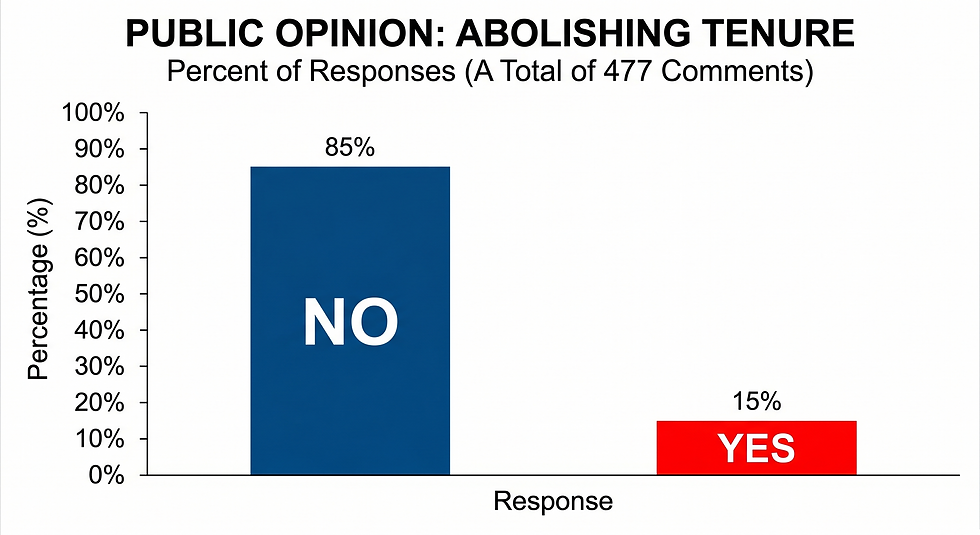
Below is an AI summary of the actual comments received as of 24 April midnight.
The suggested comments are below this analysis
While the provided sources do not contain an official statistical tally, an analysis of the individual comments provided in the comments reveals a heavily skewed response. Based on the distinct opinions expressed, an estimated 85% to 90% of the comments are strongly opposed to the proposed policy, while a small minority of respondents support the concept of accountability or "pruning" underperformance, even supportive comments often suggest technical revisions to timelines and procedural safeguards.
-
270 comments were submitted between 6-24 April
-
The average comment was 425 words in length
-
15% were short (<100 words) consisting of "Vote No" or brief emotional appeals
-
50% were medium (100-500 words) consisting of critiques to the timelines or trigger mechanisms
-
35% were long (500-1500 words) consisting of detailed scholarly analyses, many citing external research (e.g., AAUP, USC economics studies) and providing line-by-line amendments
Here is a breakdown characterizing the two sides:
Against the Policy (~85% - 90%) The overwhelming majority of commenters express deep opposition to the draft, frequently demanding that it be withdrawn, rejected in its entirety, or entirely rewritten with faculty input.
-
Erosion of Tenure and Academic Freedom: A major point of contention is the mechanism that triggers a post-tenure review. Under the proposed policy, a review and potential dismissal can be initiated by a "below expectations" or "unsatisfactory" rating in just a single workload area (such as teaching or scholarship), even if that specific area represents less than half of a faculty member's total effort allocation. Many faculty view the transition from a developmental model to a dismissal-oriented model as the effective end of tenure, transforming it into a "perpetual probationary status." The most frequent complaint is that the policy effectively ends tenure by turning it into a system of constant, short-term re-evaluation, which will stifle academic freedom, silence dissenting views, and discourage long-term, innovative research. Furthermore, if a review is triggered, the policy limits performance improvement plans (PIPs) to a maximum of 12 months, followed by potential dismissal within 90 days. Faculty stress that a 12-month window is entirely detached from the realities of academic research, grant funding cycles (such as the NIH), and peer-reviewed publishing timelines, which often take several years.
-
Administrative Overreach and Lack of Shared Governance: The drafting of the policy is heavily criticized for lacking transparency and bypassing meaningful faculty input, violating the core university principle of shared governance. Substantively, the policy concentrates unchecked decision-making power in the hands of the Provost and Deans. The Provost is granted the authority to assign final ratings, judge the success of improvement plans, and initiate dismissal proceedings, effectively allowing administrative leaders to override peer-review committees. Further, critics argue the policy was drafted in "secret" by administrators without meaningful faculty partnership, violating the principles of shared governance.
-
Unrealistic Timelines: A recurring grievance is the 12-month maximum for improvement plans. Faculty argue that NIH/NSF grant cycles and peer-review publication timelines often exceed 18–24 months, making success impossible within the proposed window.
-
Consolidation of Administrative Power: Opponents strongly object to the fact that the Provost and Deans hold unchecked authority to issue "unsatisfactory" ratings, judge the success of an improvement plan, and initiate dismissal, circumventing traditional faculty peer review and shared governance. This moves away from a peer-balanced model and is seen as a risk for administrative retaliation and a "Trumpian" or "fascist" centralization of power.
-
Recruitment & Retention: Dozens of comments warn that VCU will suffer a "brain drain" and fail to recruit top scholars if it adopts such a punitive policy, pointing out that peer institutions in Florida adopted similar measures only because they were forced to by state law.
-
Negative Institutional Impacts Critics warn that the policy directly contradicts VCU's "Quest 2028" strategic goals. Anticipated negative consequences include:
-
Harm to Recruitment and Retention: VCU will likely suffer a "brain drain" as top scholars leave for—or choose to be hired by—institutions with stronger, more stable tenure protections
-
Disproportionate Impact on Marginalized Groups: The policy threatens to amplify existing structural inequities. Women and faculty of color, who often face documented biases in evaluations and carry heavier, institutionally undervalued service burdens, will be placed at heightened risk.
-
Misleading Justifications: The administration's comparison to peer institutions in Florida is heavily criticized. Faculty point out that Florida universities adopted similar policies due to forced state legislative mandates, not voluntary institutional best practices, making them a poor benchmark for VCU.
-
For the Policy (~10% - 15%) A small but distinct minority of commenters express clear support for the policy, arguing that it is a necessary mechanism for accountability and institutional health.
-
Accountability and Parity: Supporters argue that tenure should not be a guarantee of permanent employment without continued contribution. Some, particularly term (non-tenured) faculty and staff, argue that the policy creates a leveled playing field and equitable working conditions, as they are already subjected to regular performance reviews.
-
Fair and Reasonable Structure: Several supporters state that the policy is actually quite reasonable and thoughtfully structured. They appreciate that the review focuses on support rather than punishment and includes a structured improvement plan.
-
Addressing Underperformance: Some commenters bluntly express that the policy is "way overdue" and necessary to "prune the dead wood" or handle the unfortunate instances where a tenured faculty member "checks out".
Mixed/Conditional Comments It should be noted that even among some of the comments expressing support for the idea of post-tenure review, there is hesitation regarding the specific mechanics of this draft. For example, some faculty who support holding underperformers accountable still caution that a 12-month timeline is too stringent and should be expanded to 18 months, two years, or three years to account for realistic grant and publication cycles.
Example comments below
Sample email to university council representative:
Subject: Stop the New Post-Tenure Review Policy
Dear faculty caucus members on VCU’s University Council,
I am writing to you in your capacity as my faculty caucus representatives on the University Council to ask that you oppose the proposed Post-Tenure Review policy currently open for public comment. This policy’s implications are far-reaching. As currently drafted, it poses serious risks to faculty welfare, academic culture, student success, and VCU's institutional reputation.
I respectfully urge you and your fellow University Council members to vote against this policy and to call for a transparent, faculty-led redrafting process through proper shared governance channels. Thank you for your attention to this matter and for your service as our representatives.
Thank you